
This website monitors daily breaking news about pedestrian-involved collisions in Ontario, Canada. Each collision is geocoded and tagged to describe the location, date, time, and number of pedestrians injured or killed.
 Pedestrians.ca is maintained by Gary Smith. I’m a web developer living and working in Toronto, Ontario. I have a degree in Computer Science, and I'm currently studying Geographic Information Systems part time at Toronto Metropolitan University.
If you have feedback about this site, or would like to help me expand its scope to cover additional regions of Canada, please email me at garyesmith@gmail.com.
The current collision data can be downloaded in GeoJSON, ESRI Shapefile, and CSV formats. You are welcome to use this data in your own projects. Please let me know if you found it useful, or if you have any suggestions to improve it.
All posts here are automatically published to Bluesky at @pedestrians.ca.
Of course. The Ontario government compiles statistics about traffic collisions and releases Ontario Road Safety Annual Reports (ORSARs) every year. Individual police departments also collect statistics.
But there is a long delay between incidents and the release of the government data. For example, as of August 2026, the most most recent ORSAR available describes incidents from 2022. These reports mix pedestrian-related data with other statistics, and do not reflect more recent trends.
It is as accurate as possible given the methodology, which combines automated keyword search scripts with human moderation. Breaking news reports sometimes contain errors, and these errors may be propagated in the data here. And since the news stories are only a snapshot, any corrections or changes (such as an injured pedestrian later dying) may not be reflected in this data.
Every type of road user has unique risks, but this website tracks only pedestrian collisions. That means those who are specifically described as pedestrians in news reports, or who are described as not using a vehicle when involved in a collision. One exception is users of mobility scooters, who, like wheelchair users, are classified as pedestrians under Ontario's traffic laws.
 It is often said that pedestrians are the most vulnerable road users, lacking the protection of helmets, seatbelts, and steel frames. The most recent Ontario road safety report shows that over 100 pedestrians were killed in vehicle collisions in 2022, and over 3,000 were injured.
Even low-speed collisions can kill or seriously injure. At 50 km/h, the default speed limit in Ontario cities and towns, a vehicle driver has an 85% chance of killing any person they strike.
Yes, but the responsibilities and risks are not shared equally. Pedestrians must obey laws and protect themselves from danger, but do not typically put others at risk when they make a poor decision. Careless and aggressive drivers, on the other hand, endanger everyone.
Additionally, road infrastructure and traffic regulations were primarily created with drivers in mind. Pedestrians have historically been afterthoughts in urban planning, treated as a mere "impedance" rather than legitimate road users.
 In Ontario’s 2022 road safety report, most pedestrians injured or killed in intersections had the right of way. That same year, 11 pedestrians were killed and 183 were injured while walking or standing on sidewalks. Dutifully following traffic rules does not guarantee safety for pedestrians.
Not every pedestrian crossing outside a marked crosswalk is necessarily breaking the law. There is no single violation called "jaywalking" in Ontario. A mix of regulations dictate when, where and how it is permissible to cross mid-block in each municipality.
Traffic rules often implicitly favour driver convenience over safety. For example, in much of North America, right turns on red lights were temporarily legalized in the 1970s to save gasoline during an oil crisis. The rule became permanent, despite creating enormous danger for pedestrians as many drivers look left for a gap in traffic while accelerating to the right. Attempts to overturn right-turn-on-red laws have mostly failed, in part because fears of traffic congestion have superseded the risks to pedestrians.
Inadequate traffic infrastructure can force pedestrians to make dangerous decisions. Too often, crosswalks are placed unreasonably far apart, light cycles are interminably long, crosswalk paint is faded, and “beg buttons” do not work.
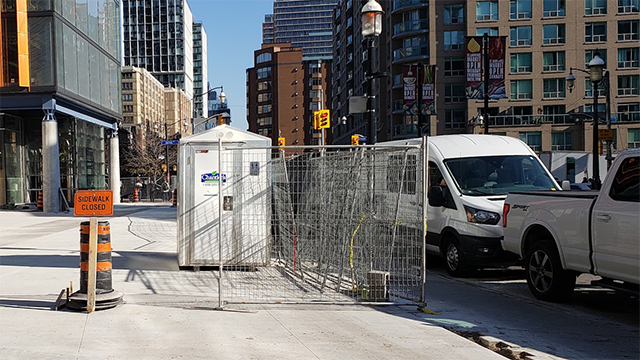 Traffic light cycles provide the same amount of time for every pedestrian to cross, whether they are young, old, able-bodied, or disabled. Parked cars, delivery trucks, signage, and construction barricades often obstruct sidewalks, leaving pedestrians to improvise their routes and balance safety with the need to get to their destination on time.
Meanwhile, so-called minor driver infractions such as speeding, rolling stops, blocking crosswalks, or making turns without yielding to pedestrians are rarely enforced strictly. Many people see traffic enforcement as a waste of police resources or a simple "cash grab" despite the fact that far more Canadians are killed by drivers each year than by criminals with guns or knives.
Hundreds of thousands of charges against Ontario drivers were withdrawn in 2025 due to traffic court backlogs. In Toronto, automated speed cameras were repeatedly vandalized before being banned altogether by the Ontario government in October of 2025. By May of 2026, Toronto speeding incidents had increased 200%.
In recent decades, personal vehicles have steadily grown in physical size and weight, a practice sometimes known as “carspreading”. This is a result of several factors, including:
Additionally, the exclusion of SUVS from the strictest levels of environmental regulation in the US made them more profitable for manufacturers, which led to the discontinuing of many compact vehicle models.
Larger vehicles are more dangerous for pedestrians, and a recent studying found that taller front-ends on cars may have contributed to hundreds of additional pedestrian deaths in the US compared to traditional lower hoods.
Canadian automotive designs and safety standards largely mirror those in the US.
Pedestrians who survive serious collisions often have life-changing injuries that lead to physical disability and economic hardship. To make matters worse, car-free pedestrians cannot purchase collision insurance to preemptively protect themselves. If pedestrians are also car owners, they may be covered by their own auto insurance. Otherwise, they are at the mercy of the driver’s insurance, or a government claims fund if a hit-and-run driver cannot be identified.
Recent changes to driver insurance laws in Ontario are intended to save drivers money, but they may also offload even more risk onto pedestrians and hit-and-run victims.
Not everybody can drive, or wants to. Some people are not physically able to drive, and some find it very stressful. Many new residential buildings do not provide parking for all residents. In dense urban neighbourhoods, driving can be more of a hassle than a convenience.
Cars are also much more expensive than they were a few decades ago, with the average cost of car ownership in Canada now exceeding $1,300 per month ($15,600 per year) when leasing, insurance, gasoline, maintenance, and parking are considered. Some people prefer to put that money towards other things, such as rent, mortgage, or food.
Besides, most Canadians already agree there is too much traffic congestion. Every person walking (or riding a bike, or taking public transit) is one less person taking up space in a lane with a large personal vehicle. Everyone, including car owners, benefits when people don't feel compelled to make every trip inside a motorized vehicle.
On its own, it probably can't. But the more data we have, the better we can determine what changes might be most effective at reducing pedestrian collisions.
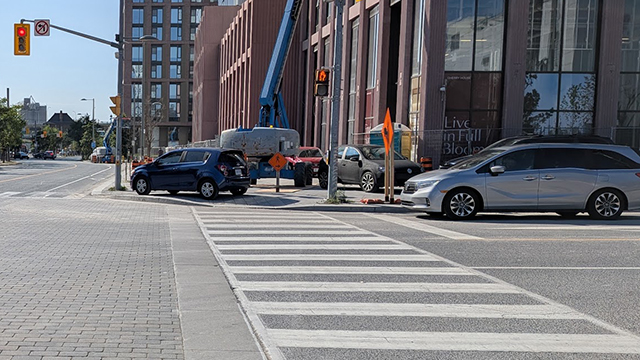 The long-term goal of this site is to track and compile information over time into a data repository that can be used for GIS analysis. For example, a robust pedestrian collision data set could be used to compare collision rates across time and space, to find patterns in the locations where most collisions most often occur, or to correlate population density with the risk of pedestrian collisions.
Change is possible. A global perspective shows that pedestrian collisions are not just accidents or isolated mistakes, but are instead a result of the collective choices we make as a society. Pedestrian fatality rates in Europe are far lower than in North America, due to different traffic laws, infrastructure designs, and vehicle regulations. Some of what works there could also work in North America.
Initiatives such as Vision Zero have proved effective in places where they have been rigorously implemented. Advocacy groups like Walk Toronto continue to push for positive change. Initiatives to pedestrianize busy city streets and make them accessible to non-drivers are also helping to slowly challenge the idea that public streets are only for those in cars.
Everyone is a pedestrian sometimes, and even the most dedicated driver transforms into a pedestrian when they park and exit their vehicle. Streets that are safer for pedestrians are safer for everyone.
Ontario Ministry of Transportation. Ontario Road Safety Annual Report 2022. Table 2.14: "Apparent Pedestrian Action by Severity of Injury." 2026.
Lewis, Aidan. Jaywalking: How the Car Industry Outlawed Crossing the Road. BBC News. 2014.
Canadian Association of Road Safety Professionals (CARSP). Rethinking Right Turn on Red (RTOR). 2020.
Toronto Star. 140,000 Fewer Speeding Charges: How Toronto Police Traffic Tickets Fell by Two-Thirds, Even as Deaths Spiked. 2019.
CTV News. Thousands of Charges Against Drivers Withdrawn in Ontario as Critics Decry System in 'Shambles'. 2025.
CBC News. All of Toronto's Speed Cameras Are Gone. How Did We Get to This Point? 2025.
CTV News Toronto. Speeding on This Toronto Street Up More Than 200% Following Speed Camera Removal: Data. 2026.
Transport & Environment. Ever-Bigger? Car Size at a Crossroads. 2026.
Car and Driver. New Study Shows That Tall Hoods Cause Hundreds of Deaths Per Year. 2026.
CTV News Toronto. Some People Injured in Hit and Runs Have Benefits Slashed Under New Ontario Insurance Regime. 2026.
Think Insure. What Is The Total Cost Of Owning A Car In Canada? 2026.
Buehler, Ralph, and John Pucher. Overview of Walking Rates, Walking Safety, and Government Policies to Encourage More and Safer Walking in Europe and North America. Sustainability. 2023.
Vision Zero Network. What Is Vision Zero? n.d.
Walk Toronto. Walk Toronto. n.d.
CTV News Toronto. Toronto Is Looking to Have More Pedestrian-Friendly Streets. What Could That Look Like? 2026.